

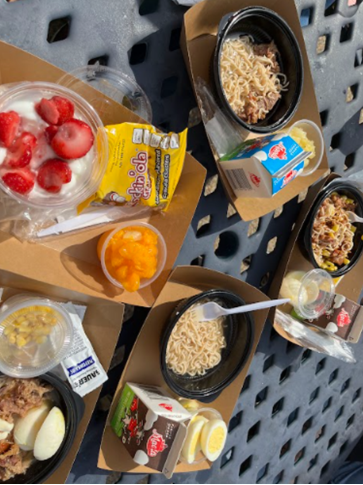
Students at Manchester were interviewed on their thoughts about school lunches to gain understanding in how people feel about their school distributed mid-time meal. Kennedi Spruill, a Senior at Manchester High School when asked about her thoughts on our school lunches observed, “It’s great that our school lunch is free, but with it being free some of the food isn’t fully cooked or doesn’t have good quality.”
The U.S. Department of Agriculture-Food and Nutrition Service article on National School Lunch Program and Meal Pattern states that as of July 1, 2024 the average calories for a five day week that a school lunch would provide is 750 – 850 calories. Kinder Pediatric Urgent Care Informs in their article about How Many Calories Does a Child Need in a Day, they state that girls aged 14 – 18 need 1,800 to 2,400 while boys between 14 – 18 needs 2,000 to 3,200 along with active athletes who can require up to 5,000 calories a day.
Spruill stated, “They need to give bigger portions, nobody can just survive off of 5 corndogs.” With Senior Jojo Ellis adding, “Some kids don’t have the opportunity to eat at home, so the portions for people like that are not very good.”
Realfood.gov discloses that per day your diet should consist of 3 portions of a vegetable per day, 2 of a fruit per day, 1.2 to 1.6 grams of protein per kilogram of your body weight per day, and 2 to 4 portions of whole grains per day. The U.S. Department of Agriculture-Food and Nutrition Service article on National School Lunch Program and Meal Pattern states that as of July 1, 2024 that on average a student receives 1 cup of fruit, 1 cup of vegetables, ½ a cup of Dark Green Subgroup (Broccoli, Bok choy, Collard Greens, etc.), 1 ¼ a cup from the Red/Orange Subgroup (Red/Orange Peppers, Tomatoes, Carrots, etc.), ½ a cup from the Beans, Peas, and Lentils Subgroup (Green Bean, Kidney beans, etc.), ¾ a cup of Other Vegetable Subgroup (Mushrooms, Asparagus, etc.) 1 ½ cups from and subgroup of vegetables, 10 to 12 oz of grains, 10 to 12 oz of meat or meat alternatives, and 1 milk.
“I feel like some of this food is more unhealthy than your local McDonald’s or Chick-fil-A…it’s just like chicken sandwiches basically every other day and cheeseburgers the other days, it’s just really not good for a kid’s physical health,” observed Ellis.
The U.S. Department of Agriculture-Food and Nutrition Service article on National School Lunch Program and Meal Pattern informs that all 5 vegetable subgroups are incorporated into school lunches along with a portion of fruit, grains, and a meat or meat alternative.
Alex King, Senior at Manchester commented, “I think the variety is great but the fruits could be executed better.” With Ellis adding, “It’s really just not good… it turns more into the same thing every year like back in elementary school.”
When asked if they had any final thoughts, questionee’s gave their final notions: King noted, “We all know they are made with the cheapest and lowest quality grade foods, it’s really bad…I think school lunches need to stop trying so many different meals and start trying to keep the food stocked and high quality, standards need to go up.”